

Gore Vidal, Re-revisited
A response to Ross Barkan's revisitation.

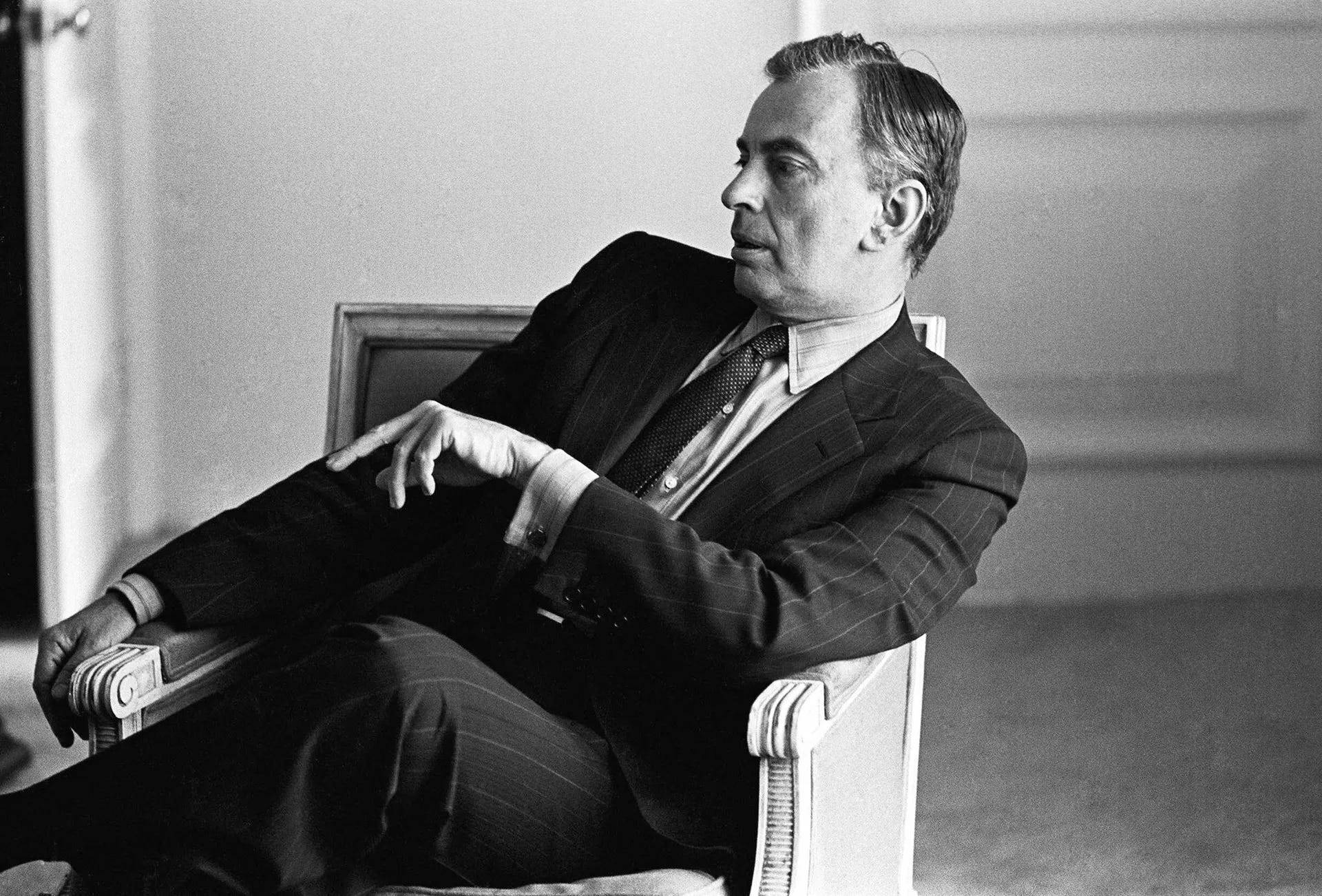
The tireless
, of whom it has been said (by me) that even his indefatigability is indefatigable, published a revisitation of Gore Vidal this morning. My ego knows bounds, so I’ll not claim the noble title of Barkan’s frisson, but we did have a pleasantly libational conversation last week in Brooklyn about the mainstream right wing’s adoption of what were once far-left Vidalian positions – anti-NATO, anti-Deep State (neé National Security State), anti-proxy antagonism of Russia, the open embrace (in some uncloseted quarters) of homosexuality, etc. – and the further oddity of how all these positions, save the latter, had seemed to disappear from the mainstream left. (As we spoke, my five or six gin and tonics seemed to disappear just as mysteriously.)It could be said of Barkan, a one-man USAID for victims of the publishing-industrial complex, that he runs the risk of spreading himself thin with so many of his humanitarian literary endeavors, except that his range has never shown itself to be anything but quite deep wherever he turns his attention. With Vidal it runs six feet under, as it were, revisiting aspects of the Vidalian political ethos that seemed to die in concert with the great aristocrat, a plural termination that I can only explain by way of Vidal’s theory of American amnesia. (At the height of his powers, Vidal warned us he’d be forgotten.)
Barkan wagers, quite insightfully, that Vidal would not have been melodramatically flummoxed by the Donald Trump presidency nor seen it as the end of democracy. That end Vidal dated, with as much insight, to the 1950 birth of the fledgling American Empire’s National Security State apparatus, the great enemy the leftist forgave and suddenly pretended didn’t exist once the right finally acknowledged it, rechristened it the Deep State, and it went to war against Trump in his first term.
It’s safe to say Barkan would like to see Vidal back in the discourse, and as he shows it is not fruitless to speculate what Vidal might have made of the Trump era, I’ll waste no more time in doing just that myself.
Actually, I shall waste a little more, but only a paragraph. The Vidal I shall now ventriloquize is not the senescent figure Christopher Hitchens (another man we dearly miss, another man whose summa of a political opponent would have been Trump) called “Vidal Loco,” who believed 9/11 and Pearl Harbor were inside jobs, but rather the barrel-chested Senatorial candidate of the 80s. The megalithic historian of the American empire. The man whom we could cure our American amnesia by remembering. Without further adieu, I shall now part the fog.
After the betrayal of the American Revolution’s first constitution, The Articles of Confederation and Perpetual Union, by the Constitution – a polity of centralization that we’d just fought a war to be independent from, and which turned the Revolution into a mere Reformation of English monarchy – America, with her aversion to political parties and factions, became a one-party state with two conservative wings. Though they have swapped names and platforms over the centuries, today the two wings of the same party are known vestigially as Republicans and Democrats.
Each party protects the interests of the elite propertied class who administer the country, while appeasing the reactionary fringes of their constituents with just enough “wins” to make them think they are participating in a democracy, and to keep them from establishing any legitimate political parties outside the two parties’ reach. (Both parties also agree in concert to make it virtually impossible for candidates to run from a third party, making democracy virtually impossible too.)
Actual critical issues of the individual vs. the state – such as Citizens United’s assigning personhood and unlimited donational power to corporations, BlackRock’s growing rentier society, surveillance capitalism, neo/techno-feudalism, imperial presidential reform (remember when we used to talk about taking away the president’s unconstitutional power of executive order?), the National Security State’s secret twelve-figure budgets – are replaced with the simulation, nay, the aesthetic of “discourse.” This replacement is what we call the “culture war,” which is waged primarily through internet addiction (our modern opium war) and the lucrative monetization and monitorization of the addicted populace’s disorganized boredom by the very powers that the two parties equally represent.
In such “culture wars” between two equal opponents in an impotent society, legitimate ideologies that could affect the apparatus of the state are forgotten in lieu of those that could affect other citizens, something both parties love to do. (Our Constitutional structure of a centralized system rather than the original vision of America as loosely collected sovereign self-governing republics has given us this false center to fight over, and the inanity of trying to entropically legislate the actions of hundreds of millions of people we’ll never meet.) This is because at best the warring populace has only the two options of cultural reaction and counterreaction to choose from, which go on influencing each other in a death spiral of puerile reflex. Thus, as the Democrats recognized the cultural demands of its reactionary fringe constituency (gender ideologies, identity politic hierarchies – aesthetical and symbolic presentations), the legitimate left policies that had primed and saturated the culture since at least 9/11 fell into desuetude, and were repurposed by the fringe right. These would be anti-globalization (the brainchild, first, of democratic-socialists), anti-Deep State/Unconstitutional fourth branch of government, etc..
In 2016, for the first time in the modern era two populist candidates speaking to the people (and most importantly, to disaffected citizens who do not often vote) rather than the establishment emerged: Donald Trump and Bernie Sanders. Trump, although far-less legitimately anti-establishment but more aesthetically seeming anti-establishment than Sanders, was able to defeat the RNC’s attempts to silence him in lieu of one of their clone candidates, and he won his nomination through an organic democratical primary. (Republicans, having a better business sense than Democrats as America’s former majoritarian administers of the state, soon recognized the popularity of Trump and abdicated their platform in 2020, giving the keys of the entire party to just one man.) Sanders on the other hand, being actually anti-establishment – that is, seeking to actually change the establishment structure of the American economy into democratic-socialism – had a tougher road to victory. After all, 2016 was Hillary Clinton’s coronation year, and so in this primary, as well as 2020’s coordinated Super Tuesday dropout, and in 2024’s cancellation altogether of a primary, Sanders and his movement were successfully thwarted and torpedoed by the handpicked candidates of the Democrat donor class. No surprise, they lost to the organic enthusiasm of Trump, a candidate picked by his people. (Cue the steambath of self-pity that is Kamala Harris’s memoir 107 Days – a candidate for President who was not elected by the electorate of her party – and its requisite entitlement not only to our support to govern us, but to our sympathy. The Democrats should never be allowed to forget that while campaigning about democracy being “on the line,” they cancelled their Democratic primary and picked a nominee for its constituents, and then had the moronical delusion to wonder how, in contrast to Trump’s organic base, Harris could have lost.)
To go back to 2016, Trump’s victory gave America its first legitimate political contest of the modern era between the bipartisan old order of the “two party system” and Trump’s new order, behind the scenes and spilling out into the inflammations of the mass media. Thus we saw not just the age-old, wornout conflict between Republicans and Democrats, but a novel conflict between Trump and older guard Republicans, elected and unelected within Washington’s monolithic bureaucracy. It also gave the mass media and their arbitrary 24/7 news cycles an opponent against which they (and their failing viewership) could be legitimated by fighting against. Here, finally, was the enemy they’d always warned of — and helped to elect by covering him non-stop since he descended a golden escalator. Trump was, in a way, a boon to the old order. Like the artificial military conflicts the government has been prolific at conjuring to excise profit for decades, the fight against Trump is good for business.
Witnessing this drama (and the fact that Trump’s political personality is the closest America’s legitimately had to a dictator), the disaffected fringe and intellectuals of the left who had always known the DNC (and mainstream media) to be as corrupt and inauthentic as the RNC, were tricked into thinking the Democrats were a legitimate party again, and quickly re-elided into the elite donor class’s approved conformities. The battle between Trump and the bipartisan old guard of the post-World War II National Security State temporarily reified the left, who rallied to save the status quo it had always wanted to change, so much so that all footing in former definitions of “liberalism” were seemingly lost, and replaced from the top down by neoliberal corporations’ technocratic frameworks. Hence the frictionless merger between the algorithmic economic models of “targeted audience”/“customer segmentation” and identity politics.
It was forgotten, for instance, that after World War II’s metamorphosis of America into global empire, the office of the President had become that of rotating one to two term Kings, with the unconstitutional powers to declare war and do whatever else at whim with executive orders. It was forgotten that the FBI and CIA, headed by such temporary “heroes” as James Comey and Robert Mueller, were sham organizations of a metastasizing police state, a turn-key totalitarianism of “Big Brother.” It was forgotten that NATO was an imperial, hegemonic bully. It was forgotten that… that… it was forgotten…
O but my powers are fading. I am very tired, I am grown weak. I would like a very cold wet rag for my forehead, please. Thank you. For I have just given birth to a six-foot tall American aristocrat. His name is Gore Vidal. Look, he’s smiling. As am I, as am I. His fixation on legitimate reform, rather than the illusional dramaturgy of the reactionary politic death spiral, is, I think, vital. Hah, Gore Vital, that is cute, you make me laugh. I should check my own vitals now, shouldn’t I? Thank you for the flowers but I must nap. Maybe some water. I can do no more, but maybe one of you can look after Vidal now while I sleep. I am very tired, but perhaps one of you can keep Vidal going, in the “discourse.”
Good post. You’re one of the few people I have seen who recognizes that Bernie Sanders was a left populist, and Donald Trump was a right populist, and that the two parties desperately tried to prevent the populist movement from taking over, and the Democrats succeeded and the Republicans failed. My political consciousness goes back to the 1970s, so I have an actual recollection of Vidal. As an anti-communist adolescent, I was not open to his claim that the national security state was hostile to American liberty and served itself. But the older I get and the more I read the more apparent it is that he was correct about that. It’s interesting to see older -- Boomer -- leftists, who grew up opposing the Vietnam war, and who were worried about surveillance by the FBI, now claiming that there is no deep state, that it is a right wing myth. It’s an Orwellian shift that they don’t perceive in themselves. You’re also unusual and correct in pointing out that the culture war politics is a distraction created by both parties, to prevent discussion of the actual material well-being of the public, which has suffered for decades.
Top notch as usual, bro.